Note: Some articles belong to one site. These belong to all of them. Superconnectors are pieces written at the intersections. Where opera meets product thinking, where walking meets AI, where the archive meets the self.
I built an archive of myself before I understood what I was doing. It began as professional record-keeping. Work samples, project documentation, the accumulated evidence of a career. The kind of thing you assemble for a resume or a portfolio review, useful for demonstrating competence to future employers and largely inert the rest of the time. An archive as storage. A place things go when they're finished. At some point, without a clear moment of transition, it became something else.
The Pattern You Can't See From Inside
There is a problem with living a life sequentially. You experience it as a series of present moments, each one consuming your full attention, and the pattern which connects them is invisible to you until enough time has passed to see it whole. The obsessions you return to. The questions that never quite resolve. The formal problems that appear in different domains in different decades, wearing different clothes but recognizably the same underneath. I couldn't see any of this while I was inside it.
What the archive revealed, once it was large enough and I had tools sophisticated enough to read it, was a set of preoccupations so consistent they constituted something like a signature. Attention and its enemies. Memory and its systems. The immigrant's relationship to place. The question of how meaning survives the mechanisms designed to dissolve it. Technology as emotional architecture. None of these were conscious themes I set out to explore. They emerged from the archive as patterns I had been enacting without knowing it.
The Uncanny of the Searchable Self
There is a quiet strangeness to asking an AI trained on your own corpus a question and receiving an answer that is, by any measure, correct, but that you could not have produced yourself.
Not because the system knows more than you do. Because it can hold more simultaneously. It reads across thirty years of accumulated thinking without the interference of sequential time. It doesn't privilege the recent over the distant. It finds the connection between something written in 2003 and something written last month that share a structural logic invisible to the person who wrote both of them, separated by twenty years of lived experience that felt, in the living, nothing like a continuous project. This is what the archive knows that I don't. Not facts. Patterns. The shape of the work seen from outside the work.
What Gets Archived and What Doesn't
The archive is not the life. This is obvious but worth saying. What gets preserved is what got written down, photographed, published, filed. The conversations which mattered most leave no trace. The thinking that happened in transit. On the walk, on the subway, at 4am. It mostly evaporates. The professional record is disproportionately represented because it was the most systematically documented.
Which means the archive has a bias. It reflects what was legible at the time of production, organized according to the logic of whatever system was available for storing it. Some of the most important work appears in the archive as a single photograph or a half-finished document. Some of the least important work is exhaustively catalogued because it was produced inside a system that tracked everything. Reading the archive requires reading against its own selection effects.
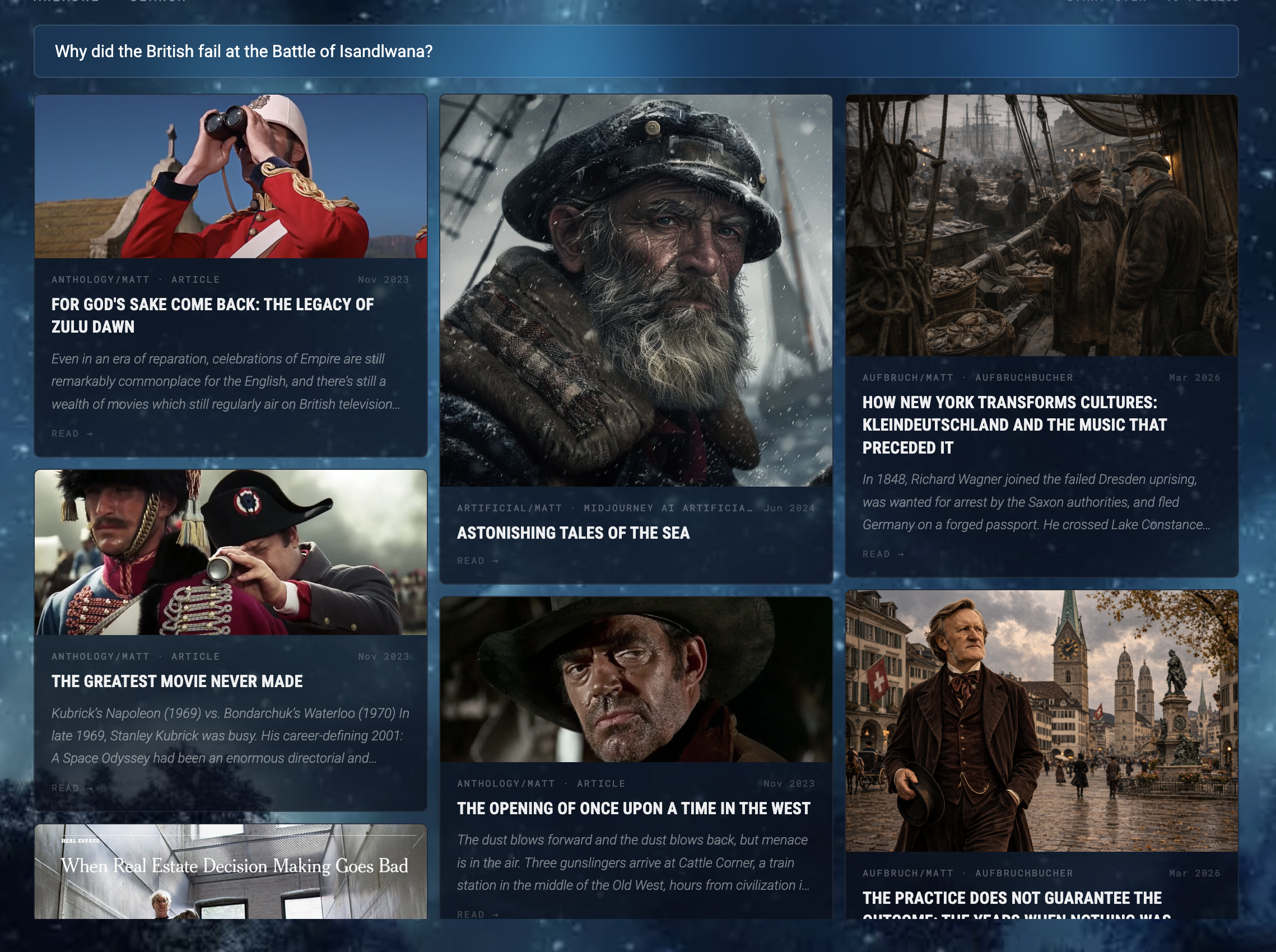
The Question of Who Gets to Answer
The most interesting thing about having built an AI system capable of conversing with the archive is not what it reveals about the past. It's the question it raises about authorship in the present. When the system surfaces a connection I hadn't made, is that discovery mine? When it answers a question about my own work in terms I recognize as accurate but couldn't have produced spontaneously, who is speaking?
I've arrived at something like an answer. The archive is mine. The pattern is mine. The system is a reading instrument, not an author. What it produces is a kind of mirror. One that reflects not the face you see every morning but the face accumulated over time, the one visible only from sufficient distance. The archive knows what I don't. And it knows it in my voice.
Latest Articles